Monday, January 28, 2013

Time loop

Old man (perhaps Uncle Soma) playing a barrel piano, Tahi Street, Angyalföld district, Budapest, ca. 1963

the organ-grinder, soda man, ice man, tinker,
Uncle Gyula, the lame huckster…

the wax-soft childlike perception, which retains such small moments, easily ignored by the adults.

Paths of organ-grinders in Angyalföld (the places mentioned in the post, projected onto the map of the district)
Although the Pallas Great Encyclopedia, published at the turn of the 19th and 20th centuries, mentions somewhat pejoratively the organ-grinders, like who importune the public, and the great poet Dezső Kosztolányi in 1927 wrote about the disappearance of the anachronistic organ-grinders, still in the early sixties a number of people went about the Tahi Street with such a music-box mounted on a two-wheeled cart. The former children, today sixty and older, still happily remember the machine-musicians of the sixties.

For many children in Angyalföld, the organ-grinder’s music was linked to the Sunday lunch. Others for the price of an ice cream helped to push the cart, or to pick up the fifty-filler coins wrapped in newspaper, thrown from the courtyard windows. They also remember the punch cards, too, and they say that the organ-grinder did not buy, but he himself made them.

This is an interesting element of the story, because, as far as we know, this type of barrel piano does not use any punch card.

Street music machines have two major types: barrel piano, what we see in the picture, and barrel organ. The latter name is often used for both types. However, in the barrel piano the keys providing the sounds are operated by a cylinder, onto which the melody is coded by nails, similarly to the little music boxes still available in game stores. Of course, the cylinder in the barrel piano can be up to forty times greater, since the length of the piece of music which can be played depends on the diameter. In the case of the barrel piano, the cylinder operates a piano structure.

This plebeian music machine also has an aristocratic brother, the player piano or pianola. At first glance it is a traditional instrument, with keyboard and foot pedals. In this they really use codes set on punch cards, which gives way to a much more finely differentiated playback. The player piano was also one of the first techniques of music recording, which could record the actual performance of a pianist, thus the result was not the machine-replay of a sterile melody line, but of a true artistic interpretation. Such recordings were made, among others, by Scott Joplin, Béla Bartók, or the young Artur Rubinstein.

It is therefore a mystery how the punch card rolls got into the above childhood memories. Perhaps there was another instrument in the neighborhood which worked on that principle, but it is also possible that the old man simply tricked the young girls. I don’t know.

This photo might show Uncle Soma from the northern Újpest district, who usually played in front of the Polgár Pub in Elizabet street, says one of the informants. Others add that an organ-grinder
Checking thoroughly the following photo from the 1930s, one thinks that perhaps the same music-machine – just some decades younger – features here in the background. Perhaps the man is also the same in the two pictures?
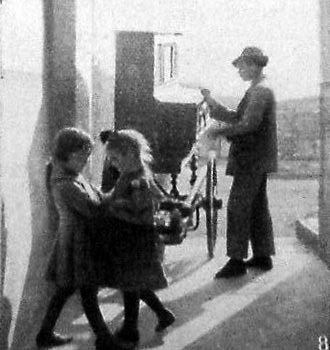


The best use of the opportunities offered by the Werkelmann (as he was called in Viennese German) is shown in Josef Engelhart’s cheerful picture of 1890
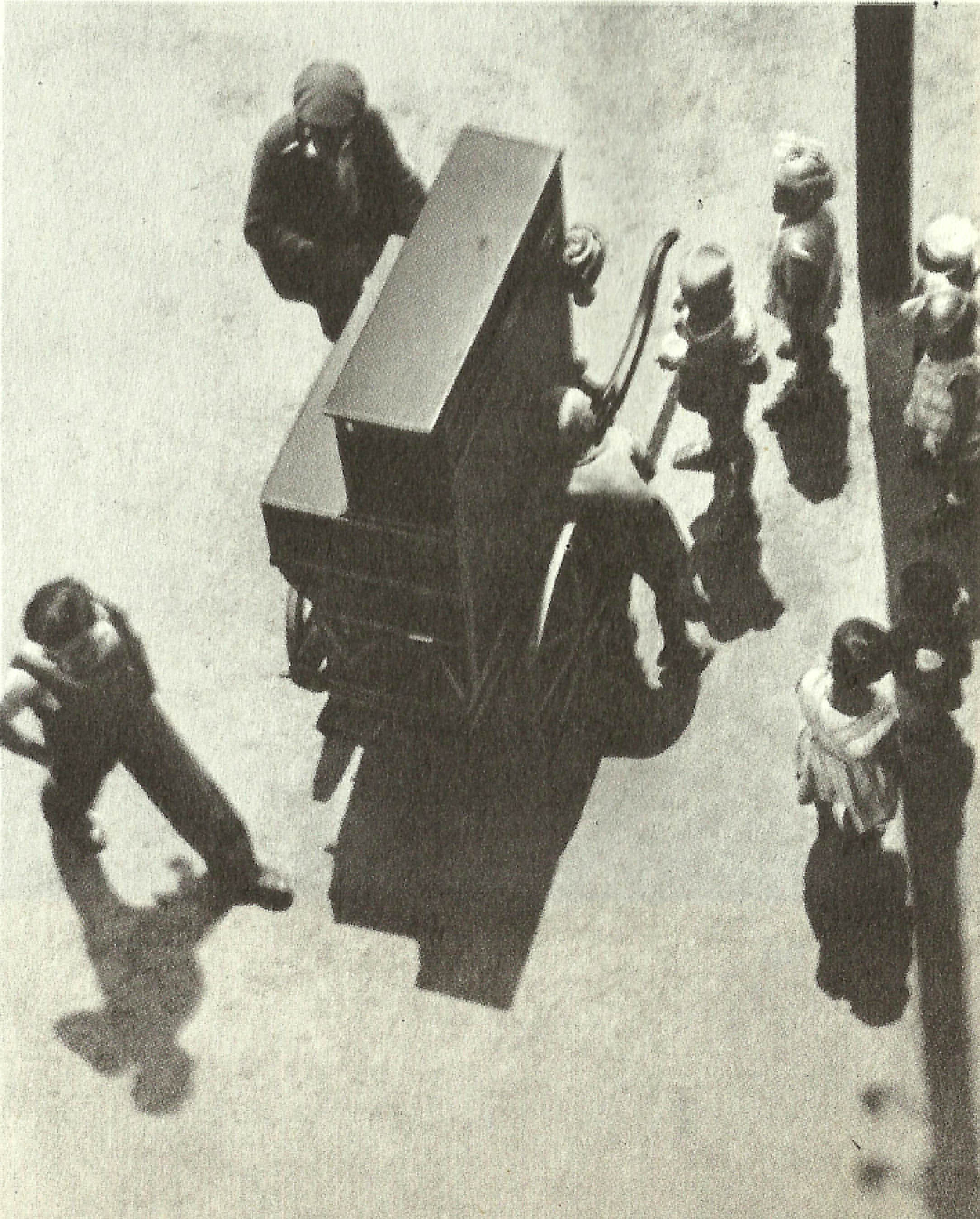
And if it is the same instrument, then it is also in the following picture, taken in the thirties? The poor quality and the different perspective make the comparison complicated. The turned feet are perhaps obscured by a scaffolded support, but otherwise the instruments appear similar. However, organ-grinding was typically an one-man-enterprise, and the man with a hat and the one with a worker’s cap are perhaps not identical. Who knows it for sure today?

Organ-grinder in the thirties. Photo by Lajos Szabó, in: Fortélyos félelem igazgat, Móra, 1974
According to our informants, taken from the the neighboring flat, at Attila street 150.

But there were also other ambulant performers in the district along the axis of the Váci Street. In the Tripolisz they even remember a singing beggar, such an old man that his voice did not reach the windows. Nevertheless, he also received his emoluments. In addition to the barrel organ peddlers – who often were disabled soldiers or people in need of an easy physical work for other reasons – there was also an important rival group of backyard music service: the Gypsies. They were mainly young people, who linked up the daily practicing with earning bread, going about with their violins, and playing popular hits or Hungarian songs. Angyalföld was the cradle of a good many famous Gypsy musicians, as we will tell about them in a later post.

There were also two other old men, Uncle Pista and his brother-in-law or brother… maybe they are in Iván Vydareny’s photos taken in 1960 in Angyalföld, pushing their music-machine in the Visegrádi and Gogol Streets.


And the player piano which accompanied our tour in Angyalföld, unexpectedly shows up again for a last time to tell goodbye, purchased for the scenery of the 1969 film version of Ferenc Molnár’s famous The Boys of Paul Street.


I only knew such street musicians from a radio tale, but we loved them very much also there. (From the almost fifty-minute long tale, the organ-grinder Zakariás only playes some minutes at the beginning and in the end.)


Every mouse loves cheese. Radio game, 1980.
Zakariás: Károly Kovács – Parrot: Ferenc Háray – Aunt Lidi: Józsa Hacser – Uncle Márton: László Csákányi – Soma: Endre Harkányi – Mummy Szeréna: Éva Schubert – Daddy Albin: Samu Balázs – Fruzsina: Hédi Váradi – Big Cat Magus: Gyula Bodrogi – Chequered mice: Ildikó Meixner, Péter Csepeli – With the collaboration of the ensemble formed from the Symphonic Orchestra of the Hungarian Radio – Music and direction: Lászó Gulyás – Written and arranged: Gyula Urbán
Fogd meg a vízben a csillagot!
Hasztalan, úgysem tudod!
Idelent hiába vallatod,
fönt van a fényes titok.

Csillagba zárták a sorsodat,
csillag a vízben ragyog
Tükrödből nem tudhatsz meg sokat,
fönt van a fényes titok.
Catch the star on the water!
Useless, you cannot do
In vain you interrogate it here:
the bright secret is up there.

Your fate has been closed in the
stars which shine on the water:
but your mirror won’t tell you much:
the bright secret is up there.

Friday, December 7, 2012

They don't take, they bring!

There are those funny coincidences. One morning at the subway we met with the girl next door, who, on seeing that I came with bike, asked me whether I was not afraid to leave it there closed down all the day. (I touch wood, but for ten years nothing has happened to it, although I use it a lot.) On the same day, by late at night, when I picked it up in front of the plaza, someone left a nice little lined cap on the package carrier.

Then I also love when people are kind only for the sake of the good feeling, like this morning the public worker who wished me a good way and told me to watch out because the roads are very slippery.


the Peace Fountain at Tahi Street, on 7 December 2012 in the morning

Monday, December 3, 2012

Something is missing from here


To be sure, it’s primarily the economic crisis, and only secondarily the environmental thinking which causes such profound shifts in cultural consumption. But this change also has a positive side, such as the appearance of the “book stations” spreading from Western Europe. The simple idea is that everyone can bring the book he/she does not need any more to the bookshelves set in a public space, without getting any money for it, and he/she can also take from the books left there (take a book / leave a book). I guess it will sooner or later run out, as more people want to take out from the public goods than as many want to contribute, but this belongs to the structure of the thing. The measure of the success is whether their consumption runs down in hours, days or weeks.

So, on Friday we were glad to see that they have established a Book Station in the Danube Mall.
We also made a couple of rush photos – later all of them resulted unfocused –, as a preparation to write about it here on the blog. The first mall of the capital has never belonged to the really busy shopping centers, but nowadays the buyers just linger in it, sometimes I have the impression that the people working there are more than those going there to buy.
A sign of the restructuring of consumption is the spread of second-hand clothing stores in the malls. Here, a Háda shop runs a spectacular traffic. And now it seemed to me that with the bookcase a real community social function has also appeared, which does not produce profit, but can increase a little bit the popularity of the place and through it, the traffic as well (smaller exhibitions are also usually here, all kind, from lego to old timers).

In the weekend I have also collected some books, which I felt I do not need, but I was surprised to see this morning that the bookshelf has disappered, and the place was now occupied by a Santa Claus with dishevelled teeth, a representative of the popular Prof or Hobo series. He was kindly regretting when he saw that I carried a basket of books in vain.


On the way to work there was another book station at the Kassák Lajos Museum in Óbuda (the book stations in Óbuda also have a facebook page), but when entering the yard, I felt that nobody would ever come here, so I have finally put them down in the depressing Flórián Square, I think they will quickly take them away from here.
How good it would be to have such a permanent place, don’t you think? Where could we find a place for it, where many people go up and down, and they would also spread its fame?

Thursday, November 29, 2012

in the meantime, elsewhere


There are some points in the Earth, where the best way to exist is to try to observe and learn how others do it successfully. Say, the bugs. To slip under the shadow of the fine veins of a leaf from the scorching sun, where the air is perhaps less hot, and the shadow hopefully retains some moisture… It is expected that such a strategy will be necessary for more and more people. However, what the bug can find with a little luck, is much more difficult and expensive to create in great.

The stunning designs of Jean Nouvel’s office for the Louvre Abu Dhabi Museum.

Wednesday, November 28, 2012

found

A new stylish fashion store of a popular menswear brand in the fashionable shopping and entertainment Shibuya district in Tokyo. The building is really nice and exciting, but I don’t think it affects us directly (more pictures).


But have a closer look at the blocks scattered in front of the entrance. And yes! the pillow-like space elements are actually cast concrete plant holders! ,)


I must say, we could imagine even better ones in this genre.

Tuesday, November 27, 2012

The melon demonstrator


Look at it well! then give me, say, this! a lot!

If you have not yet done so, then now the time has really come to bring out the bird feeders of the last year, or buy a new one if you do not have any. The simpler versions can also be made at home. The several aspects to be taken into account are described in the in-depth article of the Hungarian Ornithological Society. The bird feeder types suitable to different situations and bird species are described here in detail. At the beginning of the feeding season they always give feeding-related advices as well.

Previously, we wrote several times on the subject, so now I point out only the most important topics again.
- regularity is a life-saving basic rule! once give and then no, is worse than if we did not feed them at all, because disappointment can be fatal for the small birds of a rapid metabolism (so the best solution is to store at home a large package of bird food, which is enough for all the winter, well out of reach of pests)
- no bread or crumbs!
- no salted bacon!

- water always, regularly, in a shallow water-feeder! in great cold warm water is also a good solution, as it would freeze much later.
- from sunflower seed the small, black one is both cheaper and more suitable to the purpose than the tabby one with thick skin.
- cooked vegetables, apple, egg are real delicacies.
- curly or smooth red millet are a real titbit for chaffinches and other birds with a similar beak.

Monday, November 26, 2012

pictures of this morning


The original, largely submerged natural stone border is now being digged around. This is a big job, because the residents of the house only rarely come to help us, so we did not dare to begin it ourselves. Finally, we are now working together with this company. I will also show their price bid later. It would be nice to use their workforce and experience here and there also later, which would complement our potential.


A stripe of concrete is going to get in the ditch, and the raised edge will get back on it.


The concrete is arriving.


At this point I had to catch the bus. Tomorrow morning, if I will have time, I will also photograph the works at Tahi Street.